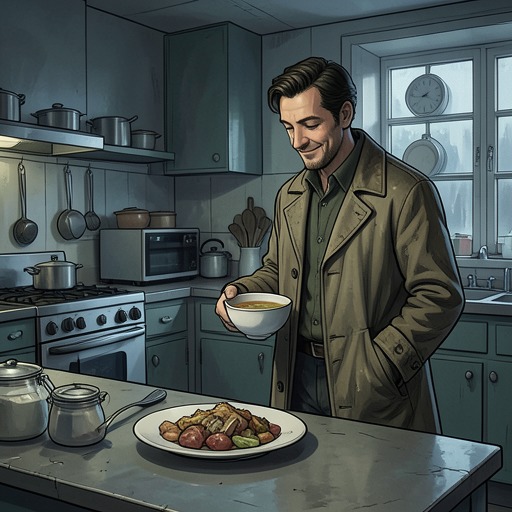
The Unconditional Right to Eat
Promise at DawnThe Unconditional Right to Eat is the narrator’s conviction that access to food must not be made conditional on obedience, assent, or submission. More than a response to hunger, it is a test of political justice: a regime is judged by whether it can guarantee nourishment to every person, without turning bread into leverage. The principle grows out of the narrator’s intimate memories of scarcity and takes its clearest form in a public humiliation in Paris.
The Principle and Its Measure
The narrator states the rule plainly: “A man should have the right to eat without any conditions.” Its force lies in the words “without any conditions.” Food is not a reward for good conduct or a privilege granted in exchange for compliance; it is a basic claim that should remain intact even when political power seeks to attach strings to daily bread. The narrator says he judges political regimes by the nourishment they can guarantee to each individual and rejects those that make eating depend on acceptance or submission.
This standard turns an ordinary material need into a measure of human dignity. In the Paris episode, the narrator is well dressed and wearing gloves, so the crowd that gathers after his collapse does not understand what has brought him down. The visible signs of respectability conceal the deprivation behind the fainting spell; the scene exposes how easily a person’s need can go unseen, and how food insecurity becomes an affront even before anyone recognizes it as such.
Poverty, Care, and Food
The principle has an intimate prehistory in Nice, where the narrator’s mother sustained the two of them through a precarious business selling luxury goods on commission. Despite her long struggle to pay for rent, school fees, clothes, and shoes, she made a beefsteak for her son’s lunch each day, presenting it with pride as a small victory over adversity. She watched him eat but claimed she could not touch the meat because she was dieting and animal fats were forbidden to her.
The narrator discovered the cost of that meal when he went into the kitchen for water and found his mother on a stool, holding the frying pan on her knees. She was soaking up the steak fat with pieces of bread and eating them; when she saw him, she tried to hide the pan under a napkin. He understood that her supposed dietary restriction concealed her own hunger. His tears and flight were not a declaration of the later political rule, but the episode made deprivation inseparable from shame, helplessness, and the unequal distribution of a meal within a loving household.
Hunger in Paris and the Principle’s Formation
Years later, after walking to a friend’s home and waiting in vain for someone to answer the bell, the narrator turned back down rue de Vaugirard. Near the Luxembourg, he passed the Brasserie Médicis and saw a well-dressed bourgeois eating a porterhouse steak with steamed potatoes. He had gone twenty-four hours without food, but he insists that hunger itself did not make him faint: he collapsed from humiliation, indignation, and rage at the thought that anyone could be placed in such a position.
The distinction matters. The scene makes the injustice of deprivation, rather than bodily appetite alone, the center of the episode. On recovering, the narrator declined the ambulance, though he thought the hospital might offer a way to fill his stomach, and walked home instead. The double shock pushed his immediate need for food into the background; he lit his lamp, took out his fountain pen, and began a story that appeared in Gringoire a few weeks later. Artistic work thus followed the collapse, turning indignation into writing rather than treating the episode as a merely private misfortune.
Pleasure, Sharing, and Human Dignity
The narrator’s account of food is not limited to deprivation. He recalls buying a pound of pickled cucumbers and eating them in the sun, preferably by the ocean, as one of the great sources of happiness in his life. Eating lets him feel that he is taking possession of the landscape, while the simple pleasure of giving himself completely to something makes life seem worth living. This abundance of sensory delight stands in contrast to the Parisian scene: food can offer pleasure and belonging, but its absence or conditional provision can reduce a person to humiliation.
A smaller encounter at the Capoulade adds a social counterpoint. Jules, the café worker, initially protests the narrator’s appeal for food, then agrees to give him two coffees and a croissant for seventy-five centimes. The narrator leaves transformed by the croissants and becomes the café’s best customer, though Jules sometimes worries that the arrangement will get him into trouble with his boss. The exchange is limited and negotiated, not a statement of political rights; set beside the narrator’s demand for unconditional nourishment, it shows how precarious access can depend on individual accommodation. Across these scenes, the principle insists that food is at once a material necessity, a bond of care, a source of joy, and a measure of whether people are treated with dignity.